
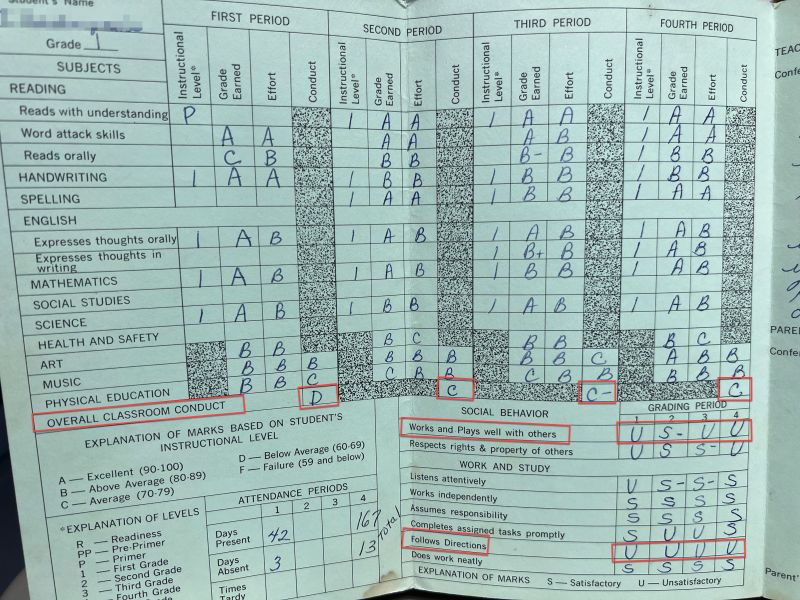
I decided to see if the top AI models could predict my career path based on my first-grade report card and I'm blown away at the results.
I tested ChatGPT 5.2 Thinking, Claude Opus 4.5, Gemini 3 and Grok 4.1 Thinking and redacted my name from the image.
By looking at my report card, I clearly didn't:
• behave
• work/play well with others
• follow directions
But I was good at:
• reading comprehension
• decoding unfamiliar words
• math
All the models nailed it but some were a little too good. This was Claude's answer:
"This kid becomes an entrepreneur or CEO — someone who builds their own thing rather than following someone else's playbook. The combination of strong verbal/analytical skills, intellectual curiosity, and a clear "I'll do it my way" attitude screams founder energy.
Bonus prediction: Something involving communication or content — those reading and verbal expression scores are too strong to ignore. Maybe a podcast host?"
The podcast host immediately raised a flag especially considering that I use a Claude Project to write the agendas for the Legal Innovation Spotlight podcast.
So I asked Claude if it cheated: "Did your memory influence your answer?" to which it responded "Ha — yes, absolutely it did!"
ChatGPT had a similarly accurate response and also admitted to using memory to influence its response.
I didn't tell the models that this was my first-grade report card.
ChatGPT and Claude inferred it.
However, Gemini and Grok also predicted the tech entrepreneur path and didn't use memory.
I analyzed their "thinking" and it appears they reasoned from first principles that I would be an entrepreneur which is true.
Gemini also predicted that my "temperament" would make me unemployable in a traditional corporate environment...also pretty much true.
Both Gemini and Grok guessed that I would gravitate towards tech and innovation.
So the takeaway here is two fold.
The models will absolutely infer facts (sometimes correctly) that weren't presented and make use of their memory in creative ways to get to the right answer.
The other takeaway is that even when they reason from first principals without gaming the exercise they can extrapolate and draw incredibly accurate conclusions.
First published on LinkedIn. Read the thread and replies.
Ted Theodoropoulos is CEO and co-founder of Infodash and hosts the Legal Innovation Spotlight podcast. He writes about legal AI strategy, law firm technology, and the economics of the law firm business model.