
More than 60% of lawyers now use AI.
Almost none of their firms have changed how the work actually gets done.
That's the finding from new research by Positive Group, RSGI, and Harvard University's Ashley Whillans, drawn from interviews with leaders at 16 firms including Baker McKenzie, White & Case, and AO Shearman.
The report has a name for the gap: accumulation. New tools layered onto old ways of working.
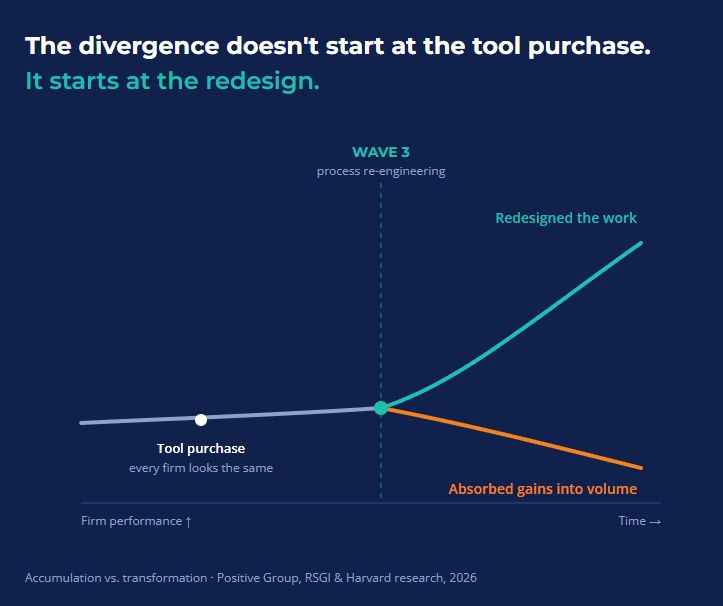
I talked about the 5 waves of legal AI transformation last week (see below) and Wave 3 is the "Process Re-engineering" phase.
Copilot licenses and Harvey seats sit on top of the same workflows, the same leverage model, and the same supervision structure the firm ran in 2019.
So efficiency gains get absorbed into volume instead of showing up in quality or margin.
The research found that the firms making real progress weren't the ones with the most advanced tech.
They were the ones whose leaders forced the redesign question. If research is instant, what should associate training look like?
If a first draft takes minutes, what does supervision actually mean?
This is where the K-shaped divergence in legal begins that I talk about in my article "How AI Will Kill Law Firms" that got over 63,000 views: views
The divergence doesn't start at the tool purchase. It starts at the redesign in Wave 3.
So here's my question for firm leaders: what workflow has your firm actually redesigned around AI, not just accelerated?
The full report is available here: The full report
First published on LinkedIn. Read the thread and replies.
Ted Theodoropoulos is CEO and co-founder of Infodash and hosts the Legal Innovation Spotlight podcast. He writes about legal AI strategy, law firm technology, and the economics of the law firm business model.