
AI didn’t break here.
It did what it’s optimized to do: make something that sounds right.
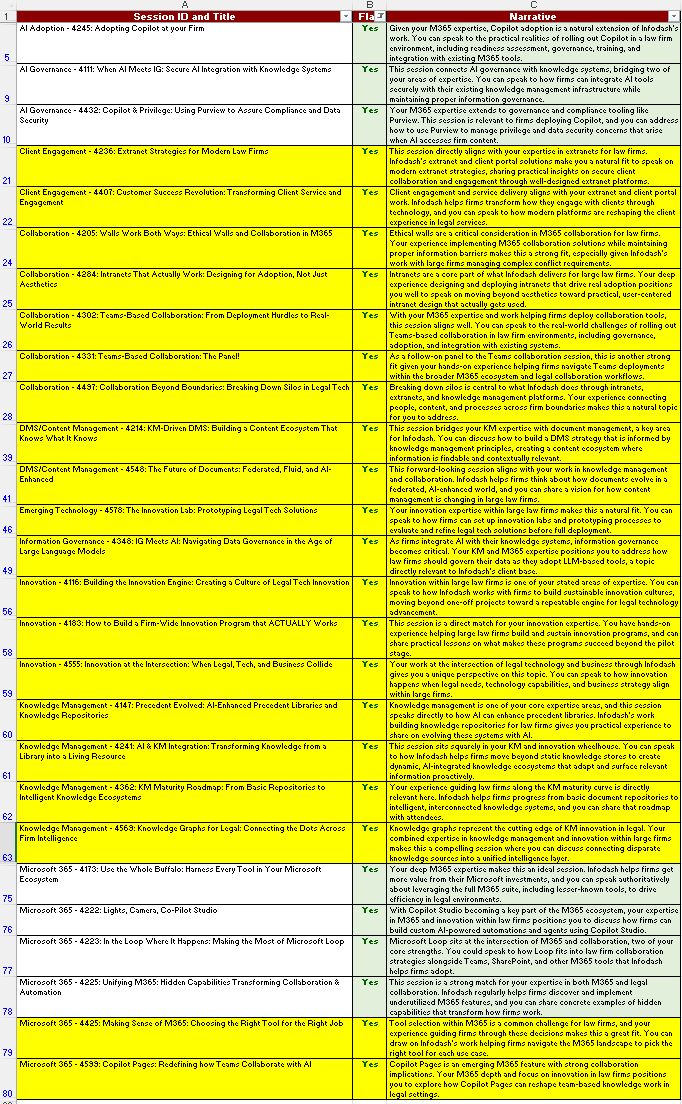
Yesterday I showed how Claude Cowork pulled 96 ILTACON sessions from a speaker application, built a spreadsheet, and flagged the ones that matched my background.
It looked flawless.
Then I actually checked the dropdown on the application page.
Several of those sessions don't exist.
In fact, 72 of the 96 sessions were either completely made up or Claude took creative license with the wording.
Confident titles. Plausible descriptions. Narratives explaining why I'd be a great fit.
For sessions that were never real.
This is the hallucination problem and it's not solved.
My theory on what happened: the model likely filled gaps in what it could find as being a good fit for me as a speaker.
It wanted to please.
I reran the prompt but left out the task of finding sessions that were a good fit and it completed the task without hallucinating.
That's the danger.
Hallucinations don't announce themselves.
They show up dressed as facts, sitting right next to real data in the same spreadsheet.
The tools are incredible. I use them every day.
Always check the output. Especially when it looks perfect.
First published on LinkedIn. Read the thread and replies.
Ted Theodoropoulos is CEO and co-founder of Infodash and hosts the Legal Innovation Spotlight podcast. He writes about legal AI strategy, law firm technology, and the economics of the law firm business model.