
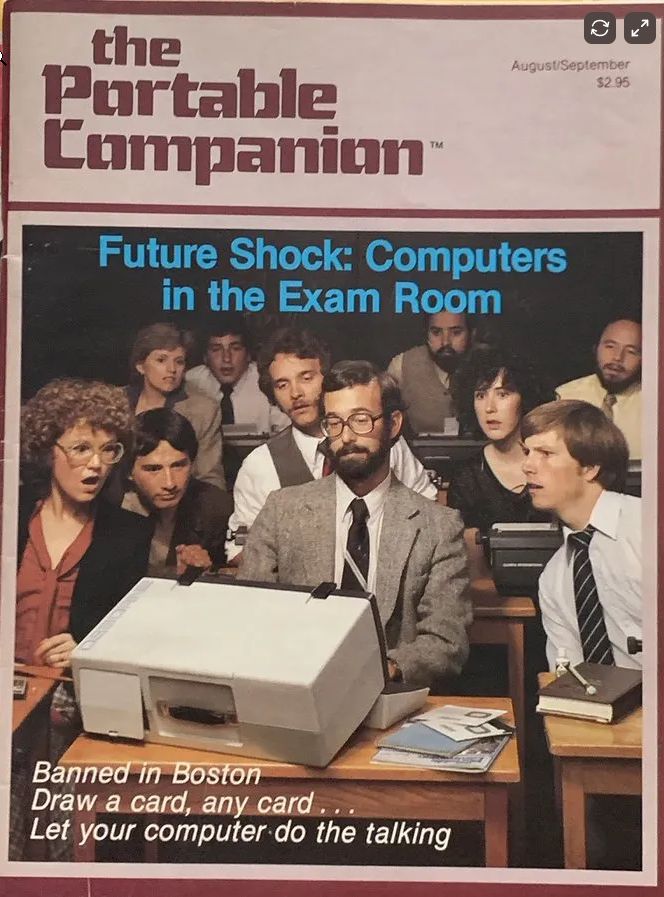
In 1982, Harvard Law School banned computers from exams.
Two 1L students brought an Osborne 1 and an Apple II to Alan Dershowitz's criminal law exam.
The story made the front page of a section of the Wall Street Journal. Time Magazine covered it.
The school held a hearing and banned word processors from "any and all forms of exams."
The concerns will sound familiar: unfair advantage, stored answers that could be "called up during exams," economic divide between students who could afford the machines and those who couldn't.
One of the banned students told the university president: "I opened the door to 21st century technology and they slammed the door in my face."
Within a few years, computers were everywhere in law school. The ban didn't slow anything down.
It just meant the institution spent its energy fighting the tool instead of figuring out how to teach with it.
Steven Sinofsky told this story in an a16z piece this week, prompted by the University of Chicago Law School's new policy restricting AI, phones, and laptops for first-year students.
He wrote that the people controlling things had no idea how the actual work would change because of the tool.
A typewriter wasn't for writing or thinking. It was better handwriting. The word processor changed what writing WAS.
That's where we are with AI in legal. New associates arriving at firms right now are AI natives.
They will use these tools no matter what policy says, the same way MBA students ran Lotus 1-2-3 before the banks they joined did.
The firms treating this as a policy problem are going to lose talent to the firms treating it as a teaching problem. And that gap compounds.
This is how the K-shape forms: not in one big strategic decision, but in dozens of small choices about whether to slam the door or hold it open.
Which side of the door is your firm on?
First published on LinkedIn. Read the thread and replies.
Ted Theodoropoulos is CEO and co-founder of Infodash and hosts the Legal Innovation Spotlight podcast. He writes about legal AI strategy, law firm technology, and the economics of the law firm business model.