
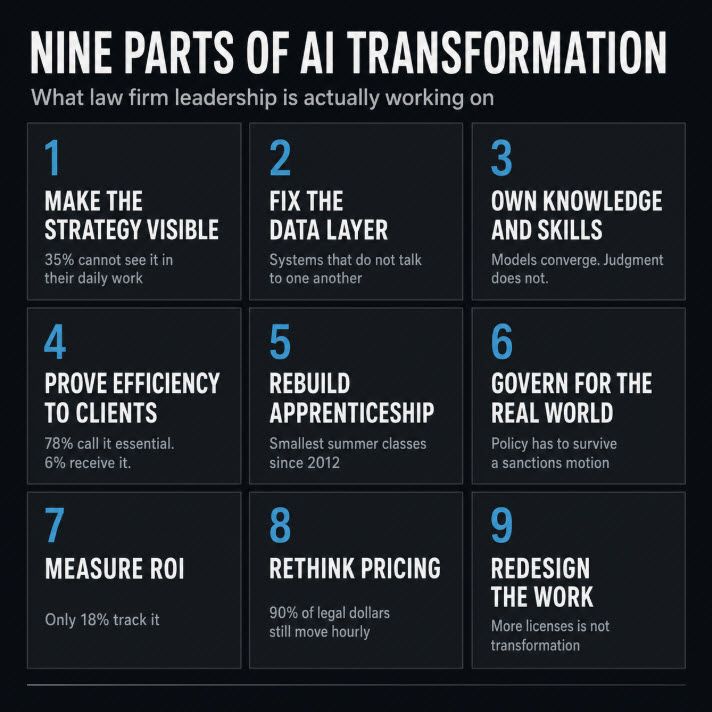
I spent the last several weeks researching what objectives Big Law leaders say they are prioritizing as part of their AI transformation and these are the 9 that show up most.
The inputs: managing partner interviews, podcasts, survey data, Georgetown, Citi Hildebrandt, Axiom’s 2026 In-House Legal AI Report, TR Institute, NALP, Blickstein, and eighteen months of conferences from all over the world. Too many resources to name.
1️⃣ Make the AI strategy visible. Most firms now have one. But 35% of professionals at organizations with an AI strategy say they cannot see it in their actual work. Firms need to bridge that gap.
2️⃣ Fix the data layer. Matter, document, client, experience, and people data are often a mess and sit in silos. AI deployments quickly hit that wall.
3️⃣ Own the knowledge and skills layer. Models are converging. Firm judgment is not. The durable asset is the owned knowledge, workflows, and learning loops. Many are beginning to believe these assets need to be decoupled from the model/platform and managed on firm infrastructure.
4️⃣ Prove efficiency to clients. 78% of corporate buyers say AI-driven quality improvement is essential. Just 6% say providers are delivering it. We're almost four years into AI and buyers are increasingly expecting firms to demonstrate efficiencies.
5️⃣ Rebuild the apprenticeship model. Summer classes at the largest firms are the smallest since 2012. NALP does not attribute that directly to AI, but AI is likely part of the pressure.
6️⃣ Govern AI for the real world. Written policies and mandatory training are not enough if lawyers ignore them and review processes fail. Hallucinations continue to make their way into documents submitted to the court.
7️⃣ Measure ROI. Technology spend rose 9.7% last year which is just the beginning of the investment needed. Yet only 18% of organizations track AI ROI.
8️⃣ Rethink pricing. About 90% of legal dollars still move hourly, while clients increasingly want value-based offerings. Firm leaders want to experiment with clients before buyers dictate the outcome.
9️⃣ Redesign the work. Transformation does not come from buying more licenses. Firms must decide which tasks change, where judgment enters, how output is reviewed, and how improvements become repeatable.
What would you add/edit/delete from this list?
And if you sit on an executive committee, which of these is truly on the agenda and which is still just conference talk?
First published on LinkedIn. Read the thread and replies.
Ted Theodoropoulos is CEO and co-founder of Infodash and hosts the Legal Innovation Spotlight podcast. He writes about legal AI strategy, law firm technology, and the economics of the law firm business model.