
The biggest legal AI risk isn’t vendor selection.
It’s giving away the intelligence your firm should be building.
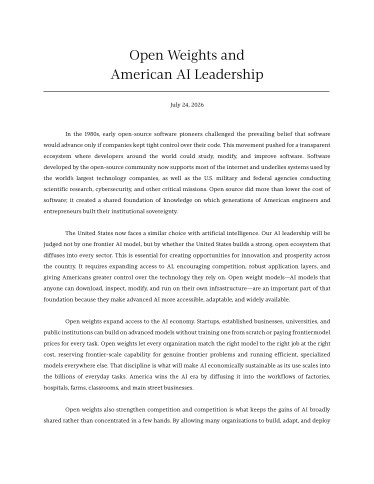
35 companies signed a letter this week arguing that open weight AI is the foundation of American technology leadership. NVIDIA. Microsoft. Meta. IBM. OpenAI. Palantir. Hugging Face. The Linux Foundation. Even DoorDash.
No legal tech company signed it. No law firm signed it.
The letter names the sectors where AI has to gain traction for any of this to matter: factories, hospitals, farms, classrooms, main street businesses. Legal isn't on that list either.
Strip out the policy language and the letter is an argument about ownership.
It says organizations should be able to "own that value through self-improving models, specialized capabilities, and accumulated knowledge."
Translated it means that the model is a commodity you rent. What you build on top of it is the asset.
Most law firms are playing that backwards.
When a firm routes its matter data, its precedent, its lawyer feedback, and its workflow logic through a single AI vendor, it isn't building an asset. It's improving someone else's.
The contract renews in three years, the price moves, and there's no leverage, because everything the firm learned lives in a system it doesn't control and can't take with it.
The skill layer is tightly coupled to the legal AI platform the law firm rents.
The implications of that are worse in legal than almost anywhere else.
A tech company that needs to rearchitect their stack raises a round and buys its way out.
A law firm can't raise outside capital without messy work arounds. Mistakes get paid for out of partner distributions, one year at a time.
The people writing the rules for the AI economy have never read an OCG. That's fine.
But it does mean nobody is going to make this argument on our behalf.
Own the skill. Rent the model.
First published on LinkedIn. Read the thread and replies.
Ted Theodoropoulos is CEO and co-founder of Infodash and hosts the Legal Innovation Spotlight podcast. He writes about legal AI strategy, law firm technology, and the economics of the law firm business model.