
A 1990 paper by economist Paul David explains why many law firms will get AI wrong.
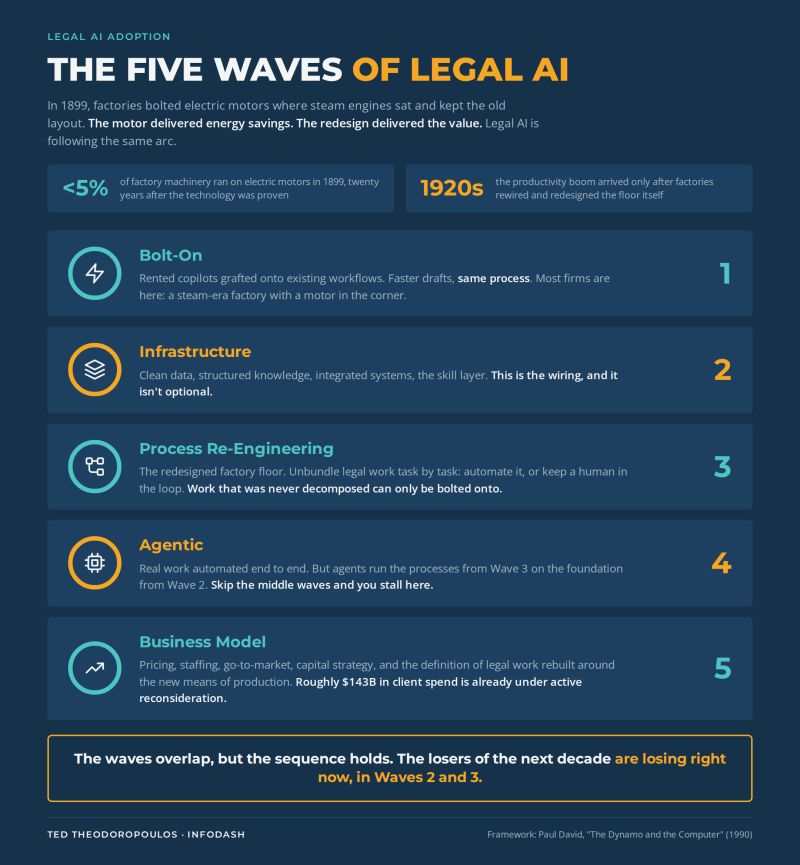
The five waves of legal AI
David studied the electrification of American factories. In 1899, electric motors powered less than 5% of factory machinery, two decades after the technology was proven.
Why the lag? Factory owners ripped out the steam engine and bolted a big electric motor in its place. Same layout, same line shafts, same belts. The gains were marginal.
The productivity boom of the 1920s took two more moves. First, wiring the building for a motor on every machine. Then the bigger one: redesigning the factory floor itself, because the old layout existed to serve a drive shaft that no longer did anything.
(Sound a bit like AI native firms?)
The motor delivered energy savings. The redesign delivered the value.
I see legal AI following the same arc, in five waves.
Wave 1: Bolt-on. Rented copilots bolted on onto existing workflows. Faster drafts, faster research, same process. This is where most firms are today. It's the steam-era factory with an electric motor in the corner.
Wave 2: Infrastructure. Clean data, structured knowledge, integrated systems, the skill layer. Unglamorous work that largely stays beneath the surface. This is the wiring, and the work isn't optional.
Wave 3: Process re-engineering. This is the redesigned factory floor. Firms unbundle legal work into its component tasks and make a deliberate call on each one: automate it, or put a human in the loop. Richard Susskind has been writing about decomposing legal work for over a decade. What's changed is that firms finally have an economic reason to do it. A matter that has never been broken into tasks cannot be selectively automated. It can only be bolted onto.
Wave 4: Agentic. Real work automated end to end. Contracts negotiated to the edge of the ZOPA (zone of possible agreement) before a lawyer ever opens the document. But agents automate the process you designed in Wave 3, running on the foundation you built in Wave 2. Firms that skip the middle waves will get stuck here.
Wave 5: Business model. Pricing, staffing, go to market, capital strategy, client engagement and the definition of legal work get rebuilt around the new means of production. Thomson Reuters' 2026 Future of Professionals report counts roughly $143 billion in legal and accounting spend that clients have put under active reconsideration. That dynamic will force this wave to happen
The waves overlap. But the sequence stays intact. You can't design processes around data you don't have, and you can't deploy agents effectively into processes you haven't redesigned.
The losers of the next decade won't lose in the agentic wave. They're losing right now, in Waves 2 and 3.
First published on LinkedIn. Read the thread and replies.
Ted Theodoropoulos is CEO and co-founder of Infodash and hosts the Legal Innovation Spotlight podcast. He writes about legal AI strategy, law firm technology, and the economics of the law firm business model.